From Chatbots to Agents: Clarifying AI Terminology in Educational Contexts

The “Biblioteca Joanina,” the eighteenth-century Baroque library of the University of Coimbra, Portugal. (credits: commons.wikimedia.org)
In my previous blog (Reclaiming Intelligence: Why “Artificial Intelligence” Needs Reframing), I argued that the term artificial intelligence (AI) deserves more scrutiny than it often receives. I questioned whether contemporary AI systems actually demonstrate intelligence in the way humans understand intelligence and suggested that what we are witnessing is not artificial intelligence but something closer to artificial assistance. That reflection emerged from a broader concern: our language shapes our understanding.
In this essay, I want to continue that conversation. I want to continue focusing on terminology when talking about AI, especially in educational contexts. My goal is not to oversimplify the topic, but to create a clearer path into it so that more readers can understand, question, and use these terms with intention.
I have always been uncomfortable with scholarship that relies on terminology it does not define. Terms should not be decorative. They should not function as intellectual shortcuts or signals of expertise. When terms remain undefined, discussions become inaccessible, imprecise, and sometimes performative.
In conversations about AI in education, terminology matters because words frame expectations. They influence institutional decisions, policy, pedagogy, and how educators understand emerging technologies.
This reflection continues my ongoing effort to bring greater clarity and intentionality to how we talk about AI.
In my writings, I have often questioned assumptions, examined definitions, and challenged popular narratives to make conversations about AI more understandable, practical, and fair. The goal is not to strip complexity away. Rather, it is to make these discussions honest and unpretentious, so that understanding AI does not remain reserved for a few or confined to the small technical circles that too often control the conversation.
If terminology matters, then perhaps the most useful place to continue is with a distinction that often goes unexplored: generative AI versus other forms of AI.
Not All Artificial Intelligence Is Generative: Generative AI versus other forms of AI
Today, the term AI has become almost synonymous with tools like ChatGPT. But this creates a misconception: not all AI systems generate content.
Historically, educational technologies have relied heavily on what scholars would call discriminative AI.
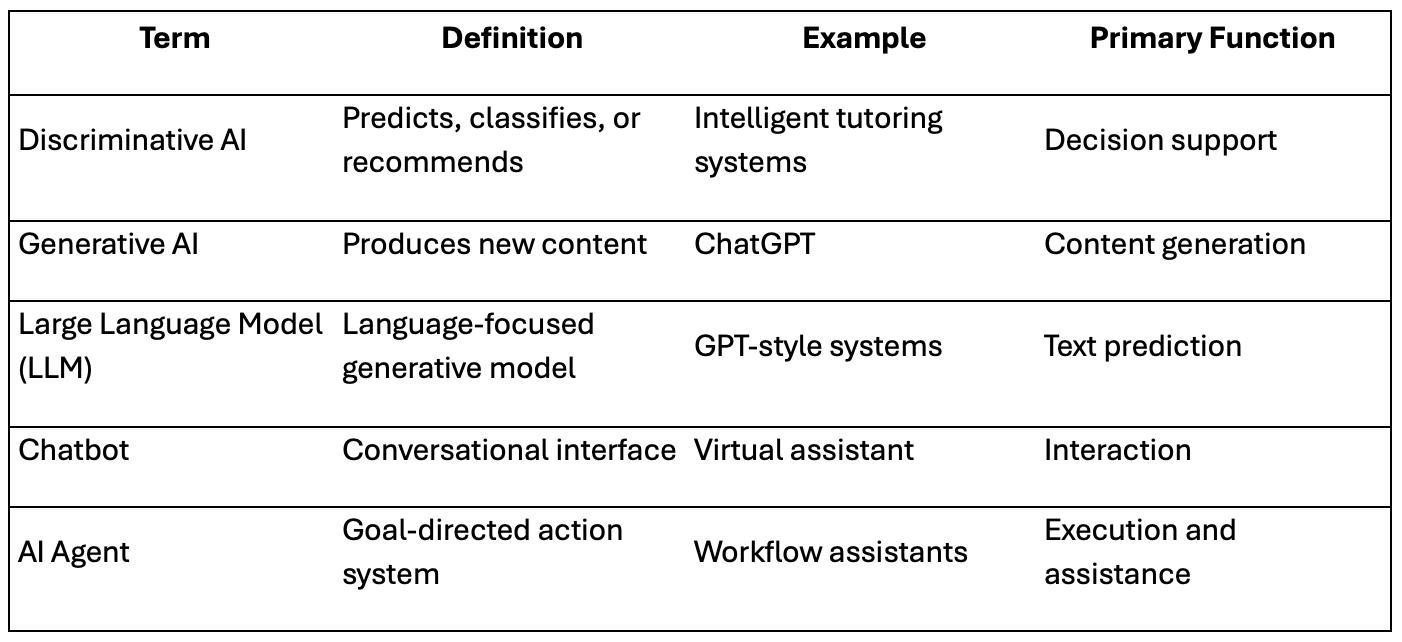
Discriminative AI refers to systems designed primarily to classify, predict, recommend, or select among existing possibilities. These systems analyze input and determine outcomes.
In education, these earlier forms of AI were designed primarily to support decisions rather than generate content or “answer” inquiries. Intelligent tutoring systems, adaptive learning platforms, automated grading tools, student success prediction models, and content recommendation systems all used data to identify patterns and suggest next steps.
Discriminative AI systems help educators and institutions answer practical questions such as: Which responses are correct or incorrect? Which lesson, resource, or learning pathway should come next? In this sense, discriminativeAI functions as a behind-the-scenes assistant, helping humans make faster, more informed choices about teaching, learning, assessment, and interventions. Its purpose is not to replace the educator’s judgment, but to strengthen decision-making by organizing information, detecting patterns that might otherwise be overlooked, and offering recommendations that educators could interpret within the broader context of each learner’s needs. Their purpose is decision support.
Generative AI operates differently because it does not simply classify information, recommend a next step, or select from a fixed set of options. Instead, it creates new outputs by drawing on patterns learned from large datasets. Tools such as ChatGPT, Claude, and Gemini can generate text, images, code, audio, examples, explanations, and other forms of content in response to a prompt (inquiry). In education, this changes the nature of the interaction: users are no longer asking only, “Which student needs support?” or “Which lesson comes next?” They are asking, “Can you rewrite this?” “Can you summarize this?” “Can you help me brainstorm ideas?” or “Can you create an example I can use in class?” The system becomes less like a decision-support tool and more like a generative partner that can help draft, revise, explain, simulate, and create materials. This shift expands what AI can do in educational settings, while also making human judgment even more important in evaluating accuracy, relevance, tone, and pedagogical value.
The distinction between discriminative AI and generative AI matters because educational expectations vary depending on which category of system we are using. Discriminative AI supports decisions by identifying patterns and recommending possible actions. Generative AI supports creation by producing new content, explanations, and examples. Confusing the two can lead us to ask the wrong questions, overstate what a system can do, or overlook where human judgment is most needed.
Large Language Models Explained for Educators
Once generative AI enters the conversation, another term appears immediately: large language models (LLMs).
Are LLMs and generative AI the same thing? Not exactly.
Generative AI is the broader category, and large language models are one specific type of generative AI. LLMs are designed to work with language. An LLM is a computational model trained on extremely large collections of text to predict likely sequences of words. This may sound technical, but the basic idea is fairly straightforward. If discriminative AI functions like an evaluator deciding among existing options, an LLM works more like an advanced completion engine, predicting what text should come next. For educators, this distinction is important because it shapes what we should expect from these systems and how carefully we must interpret and critically analyze their responses.
The human interaction with LLMs is also different. When educators use an intelligent tutoring system or another form of discriminative AI, the question is often, “What should happen next?” The system evaluates available data and recommends a pathway, intervention, score, or resource. When educators use an LLM, however, the question shifts toward, “What could happen?” The system can draft an explanation, suggest an example, simulate a dialogue, reframe a concept, or generate possibilities that did not previously exist in that exact form.
This is one reason prompt design has become so important. Prompting is not merely a technical procedure. It is a way of communicating context, goals, constraints, and human intention into a generative system. For educators, this means that the quality of the interaction depends not only on the sophistication of the model but also on the clarity, purposefulness, and pedagogical judgment embedded in the prompt (Correia et al., 2025).
From Chatbots to AI Agents: The Next Layer of Confusion
If generative AI introduced new confusion into educational terminology, agentic AI has intensified it. Terms such as chatbot and AI agent are now often used interchangeably, even though they do not necessarily describe the same thing.
What is a Chatbot?
A chatbot is best understood as an interface. It is defined largely by how humans interact with it, usually through text or voice. Earlier chatbots followed relatively simple rules: a user entered a question or command, and the system produced a programmed response. Modern chatbots often incorporate large language models, which allow them to generate more flexible and conversational replies. Still, the defining feature is the interaction itself. A chatbot is defined primarily by how humans interact with it.
What is an AI agent?
An AI agent, by contrast, is defined less by how it communicates and more by what it can do. An agent can receive goals, make decisions, use tools, complete multiple steps, maintain memory, and adapt its outputs along the way.
In education, this distinction matters. A chatbot may answer the question, “How should I create a lesson?” An AI agent may move beyond the conversation by creating lesson materials, generating assessments, revising content, organizing files, and preparing student summaries. The interaction shifts from information retrieval to delegated work to an AI assistant.
What Can AI Agents Assist Educators With?
For educators, the promise of AI agents is not that they think for us, but that they can help us carry some of the weight of time-consuming work. In instructional design, for example, an AI agent might help draft learning objectives, suggest activities, or organize a curriculum sequence. These tasks are important, but they are also laborious. When used thoughtfully, AI can create a first layer of support that allows educators to spend more time conceptualizing and refining the learning experiences.
The same is true for administrative work. Scheduling, reporting, and documentation often sit in the background of teaching and training, quietly consuming hours that could otherwise be directed toward learners. AI agents may help organize these processes, making routine tasks more manageable without removing the need for constant human oversight.
Learner support offers another promising area. AI agents may help generate personalized study plans, draft feedback, or recommend resources. But personalization is not the same as care. A recommendation system can identify patterns, but an educator understands the learner as a whole person, with aspirations, struggles, and lived experiences.
This reflects a theme that appears across my prior writing: AI only works when it is guided by human context, creativity, and judgment. AI agents may augment human capability, but they do not replace human understanding and ingenuity.
How Could Educators Begin Experimenting with AI Agents?
One accessible way to begin experimenting with agentic AI is through tools such as Gems (by Gemini) and custom GPTs (by ChatGPT). Although these systems are not considered AI agents per se, they function as configurable AI assistants that allow users to determine rules, define workflows, and explore increasingly agent-like capabilities while maintaining human oversight. They permit shaping how an AI behaves by providing instructions, defining tone and expertise, uploading knowledge sources, and sometimes connecting tools or workflows. These configurations create a more personalized and context-aware interaction, but personalization alone does not make a system agentic.
For example, the following table offers a simple way to think about it:
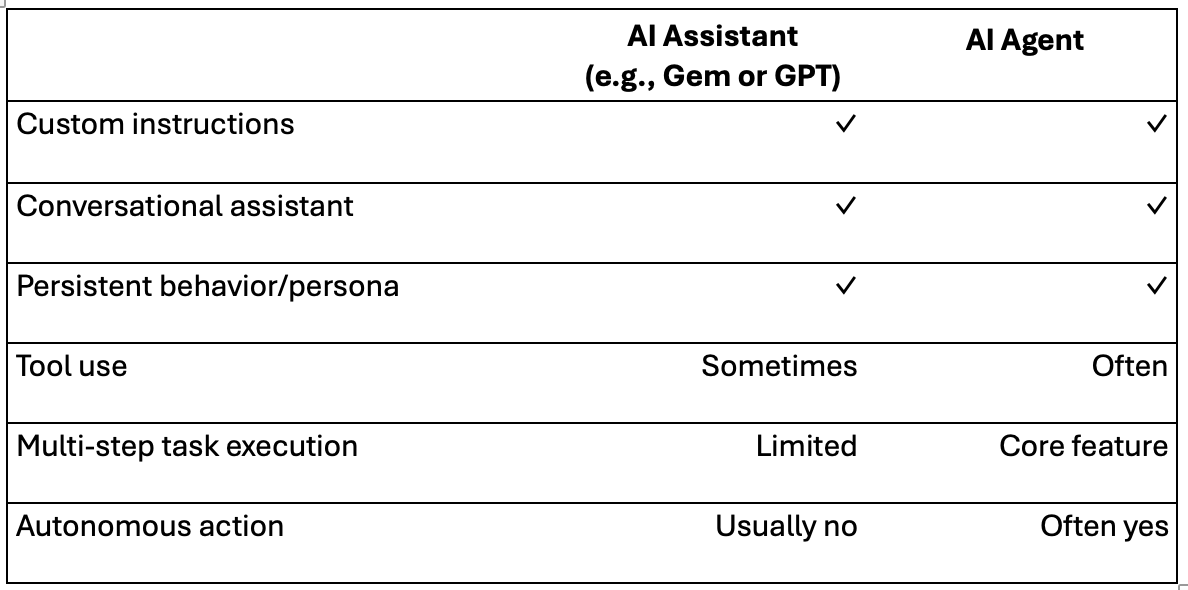
What distinguishes an AI agent is not simply conversational ability but the capacity to pursue goals through action. AI agents are generally designed to move beyond responding to prompts and instead coordinate tasks across multiple steps. They may maintain memory across interactions, retrieve information from documents or external systems, use tools dynamically, and operate with some degree of decision-making within predefined boundaries. In some cases, they may even act semi-autonomously toward an objective.
One way to think about this is as a continuum of increasing capability:
Chatbot → ConfigurableAI Assistant (Custom GPT / Gem) → AI Agent
At the earlier stages of this continuum, the human remains responsible for directing nearly every interaction. At the agentic end, the system begins coordinating actions while still operating within human-defined goals and constraints.
Consider the difference in educational practice. A Gem or custom GPT that helps instructors brainstorm lesson plans, draft syllabi, or generate activities in a preferred writing style functions primarily as an assistant. It supports thinking but does not independently carry work forward. By contrast, a more agentic system might read course materials, retrieve institutional policies, draft learning activities, organize documents, monitor progress, generate reminders, and route outputs for human review across multiple connected steps.
Conclusion: Words Matter
When we call every system artificial intelligence, we lose precision. When we confuse chatbots with agents, we misunderstand capabilities. When we treat language generation as intelligence itself, we risk inflating expectations and obscuring what these systems actually do.
Distinguishing between discriminative AI, generative AI, large language models, chatbots, AI assistants, and AI agents does not make the field more complicated. If anything, it makes it easier to understand. Definitions are not barriers to participation. They are tools that allow more people to enter the conversation with clarity and intention.
In my previous reflection, Reclaiming Intelligence: Why “Artificial Intelligence” Needs Reframing, I questioned whether the term artificial intelligence accurately describes the systems we are building today. The current essay extends that reflection by suggesting that our terminology should become more intentional, more careful, and perhaps more humble.
As AI terminology becomes increasingly ubiquitous, we should resist the temptation to collapse fundamentally different concepts into a single narrative. Not every AI system generates content. Not every generative model is a large language model. Not every conversational interface is an agent. And not every form of automation reflects intelligence.
The distinctions explored throughout this essay can be summarized as follows:

Perhaps the future of AI in education is not about developing intelligence systems at all. Perhaps it is about building better forms of assistance and interaction.
Technology may help us think, create, organize, and discover. It may support our workflows, expand access to knowledge, and reduce administrative burdens. But intelligence, judgment, context, meaning, and care remain profoundly human.
As I argued previously, we should continue to think of AI not as a source of intelligence itself, but as a form of artificial assistance that expands human cognition while preserving the human experience at the center of education.
References
Correia, A.-P., Hickey, M. S., & Xu, F. (2025). Realizing the possibilities of the large language models: Strategies for prompt engineering in educational inquiries.Theory into Practice, 64(4), 434–447. https://doi.org/10.1080/00405841.2025.2528545
Please cite the content of this blog:
Correia, A.-P. (2026, May 26). From Chatbots to Agents: Clarifying AI Terminology in Educational Contexts [Blog post]. Ana-Paula Correia’s Blog. https://www.ana-paulacorreia.com/blog/from-chatbots-to-agents-clarifying-ai-terminology-in-educational-contexts